
Old Mine Cut vs Old European Cut Diamonds: What’s the Difference?
If you have spent any time looking at antique diamond jewellery, you have probably come across the terms Old Mine Cut and Old European Cut. They are often grouped together as “old cut diamonds”, and at first glance they can look quite similar. Both have that wonderful, softer kind of sparkle that feels completely different to a modern brilliant cut.
But they are not quite the same, and once you know what you’re looking for, spotting the difference becomes part of the fun.

First, what exactly is an old cut diamond?
Before diamond cutting became the highly precise, computer-led process it is today, diamonds were cut by hand. The cutter worked with the natural shape of the rough diamond, rather than trying to achieve a mathematically perfect result. That means antique diamonds are often a little less symmetrical, a little more individual, and very rarely identical to one another.
Which, for us, is exactly their appeal.
These diamonds were also cut for a very different world. Think candlelight, gaslight and low evening light rather than bright modern retail lighting. Their larger facets were designed to catch those softer sources of light and return broad, slow flashes.
It is a different kind of sparkle. Not necessarily more. Not less. Just wonderfully different.


What is an Old Mine Cut diamond?
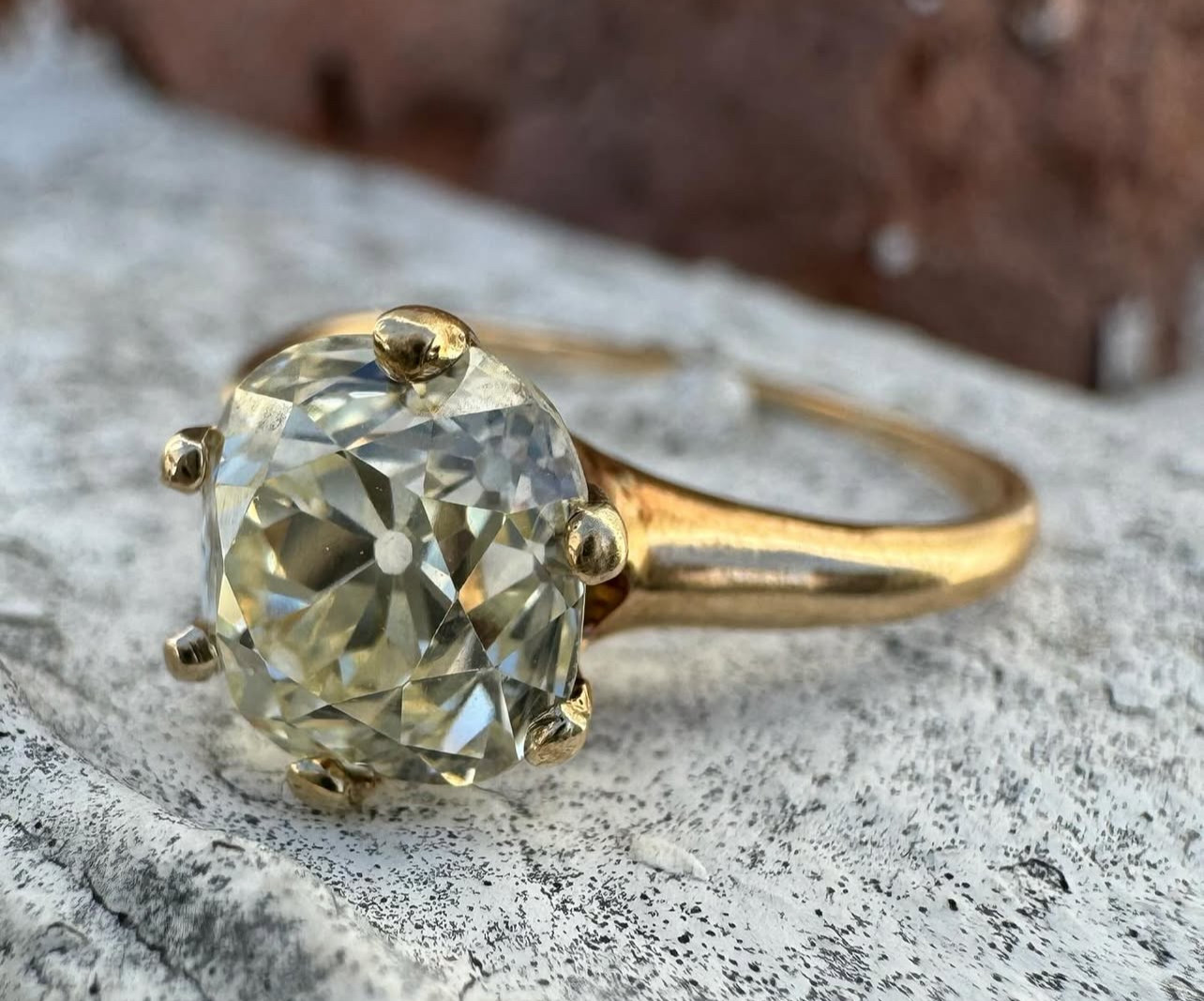
Old Mine Cut diamonds are among the earliest forms of brilliant-cut diamond and are most commonly associated with jewellery from the Georgian and Victorian periods.
Rather than being perfectly round, they are usually slightly squarish or cushion-shaped.
Typical characteristics include:
a high crown
a small table
a deep pavilion
large, broad facets
a visible open culet at the bottom of the stone
an irregular cushion-like outline
Because these diamonds were shaped entirely by hand, no two are exactly alike.
Some lean more square.
Some are beautifully wonky.
Some have wonderfully chunky facets.
And that individuality is a large part of their charm.
When an Old Mine Cut catches the light, you tend to see bold, almost flickering flashes rather than the fast sparkle of a modern brilliant.
It is a softer, moodier kind of brilliance.
Very difficult not to fall in love with.

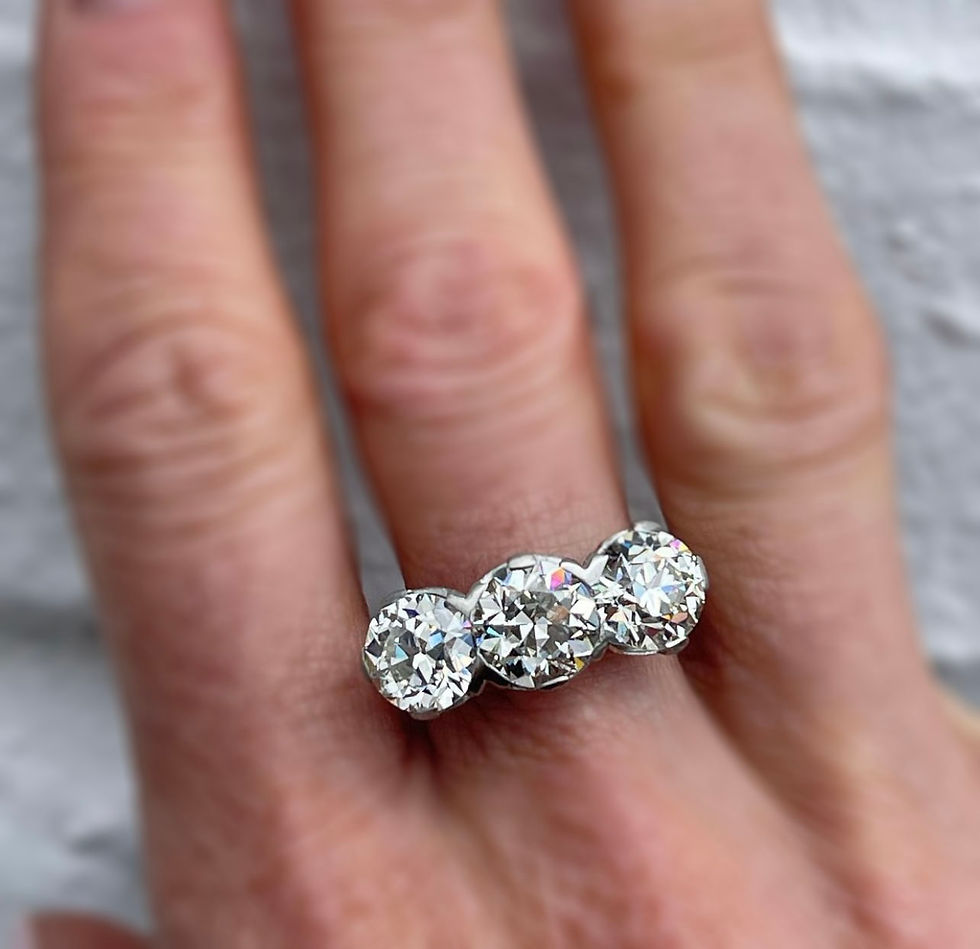
And what is an Old European Cut?
The Old European Cut came slightly later and represents an evolution in diamond cutting.
By the late 1800s and early 1900s, advances in cutting technology allowed cutters to create diamonds that were more consistently round.
An Old European Cut will typically have:
a rounder outline
a high crown
a small table
a deep pavilion
broad facets
a visible culet
more symmetry than an Old Mine Cut
They still have the beautiful broad flashes associated with antique diamonds, but they often feel a little more refined and balanced.
You could almost think of the Old European Cut as the bridge between the wonderfully irregular Old Mine Cut and the modern Round Brilliant we know today.
So what is the easiest way to tell them apart?
The quickest clue is usually shape. An Old Mine Cut is generally more cushion-shaped or irregular, whereas an Old European Cut is typically rounder.


But there is an important caveat. Antique diamonds were cut by hand. There was no laser measuring system telling the cutter they were half a millimetre out. So there are always exceptions.
Some Old Mine Cuts can look surprisingly round.
Some Old Europeans are a little irregular.
This is why we never identify an antique diamond by one feature alone. We look at the outline, facet pattern, crown, table, culet, overall proportions and - just as importantly - the jewellery the diamond is set into. The entire piece tells the story.
What is that little circle you sometimes see in the centre?

If you have looked closely at an antique diamond, you may have noticed a tiny dark circle or dot visible through the centre. That is usually the culet. On most modern diamonds, the pavilion facets come together in a sharp point underneath the stone. Many antique diamonds were instead cut with a tiny flat facet at the bottom. From above, that open culet can sometimes be visible through the table.
Today it might technically be considered an imperfection in cutting. In an antique diamond? We think it’s rather wonderful. It is one of those tiny details that instantly hints at the stone’s age and history.
Why don’t antique diamonds sparkle like modern diamonds?

Modern Round Brilliant diamonds are engineered to maximise light return and create enormous amounts of scintillation - those rapid little flashes of sparkle you see as the stone moves.
Antique cuts behave differently. Their larger facets tend to produce broader flashes of light.
The effect can be slower, deeper and more dramatic. In daylight they can be beautiful. In low light, they can be extraordinary. There is a reason people describe old diamonds as having a certain glow. Their beauty isn’t about achieving mathematical perfection. It is about character. For many collectors, once you start appreciating antique diamonds, perfectly uniform modern diamonds can suddenly feel almost a little too perfect.

Are Old Mine Cut or Old European Cut diamonds more valuable?
There isn’t a simple answer.
Value still depends on all the usual factors - carat weight, colour, clarity, cut quality, condition and rarity - as well as the desirability of the individual stone and the jewellery it is set into.
A particularly beautiful antique diamond with a desirable shape and facet pattern can command strong interest from collectors. Larger antique diamonds can also be increasingly difficult to find, especially stones that have survived without being recut into modern shapes. But age alone does not automatically make a diamond valuable.
As always with antique jewellery, it is the whole picture that matters.
Which one is better?
Neither. That is perhaps the wrong question.
Old Mine Cuts tend to appeal to people who love something slightly more irregular, romantic and unmistakably old.
Old European Cuts can feel a little more refined and familiar while still retaining all the character of an antique stone.
Personally, we think the best old-cut diamonds are the ones that make you stop looking at the grading report for a moment and simply look at the stone.
Does it draw you in?
Does it have life?
Does it have character?
Does it make you keep turning your hand toward the light?
That usually tells you far more than a label ever will.
A little note from Kin
One of our favourite things about antique jewellery is that it reminds us jewellery was never intended to be completely uniform. These diamonds were shaped by human hands. Their slight asymmetry, open culets and broad facets are evidence of another era of craftsmanship.
They have already lived a life before reaching us.
Rather than trying to make them look new, we think there is something rather special about allowing them to remain exactly what they are.
Beautifully individual.
Beautifully imperfect.
and completely impossible to replicate.
Explore Kin’s antique and vintage diamond jewellery and discover the wonderful character of old-cut diamonds for yourself.


Comments